 Arborist
Tree service insurance: what you actually need to carry
This guide explains what tree service insurance typically covers and what tends to drive cost. It isn't legal or insurance advice — coverage requirements vary by state, and a licensed insurance agent is the only reliable source for what you specifically need to carry.
Most tree services need three coverages at a minimum: general liability for property damage and injury claims, commercial auto for work vehicles, and workers’ compensation once you hire your first employee. Commercial and municipal clients frequently ask for a Certificate of Insurance (COI) before they’ll book work, so having one ready matters as much as having the coverage itself.
What tree service insurance actually covers
Tree service insurance isn’t a single policy. It’s a set of separate coverages that protect different parts of the business, usually purchased from one carrier but priced and underwritten on their own terms.
General liability covers damage or injury your work causes to someone else’s property or person: a rigging line that snaps and takes out a fence, a limb that lands on a parked car. Commercial auto covers the trucks and trailers you use for work, since a personal auto policy typically won’t. Workers’ compensation covers medical bills and lost wages if you or a crew member gets hurt on the job, and it becomes close to mandatory the moment you have employees.
Beyond that baseline, most operators eventually add equipment coverage for chainsaws, chippers, and rigging gear, and some add umbrella liability once they’re bidding larger commercial or municipal contracts. The sections below cover each of these, what drives their cost, and what a client is actually asking for when they request proof of coverage.
General liability insurance: the policy every client expects
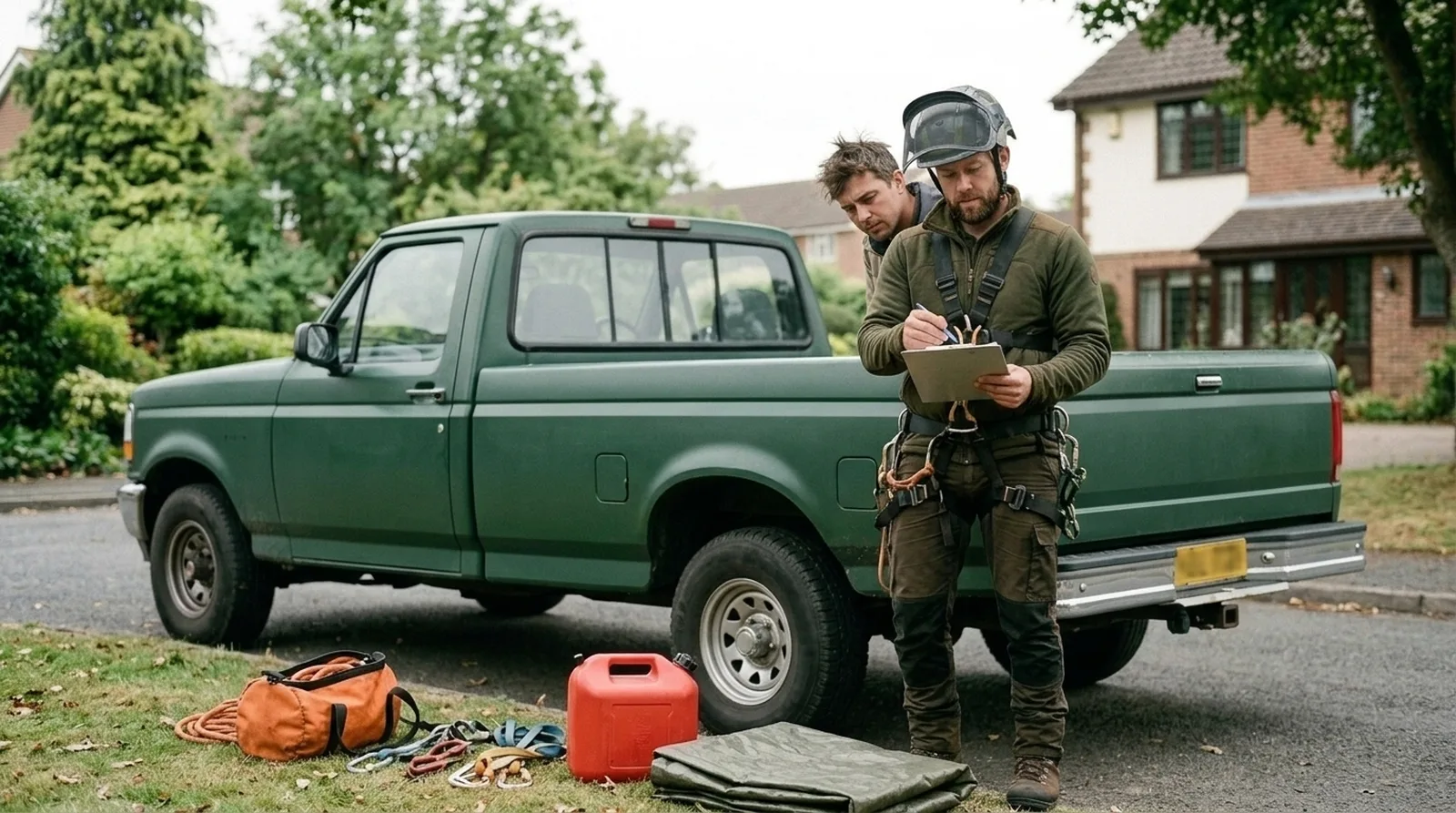
General liability is the coverage almost nobody in this trade operates without, and it’s usually the first policy an operator buys before taking a single paying job.
What it actually pays for
General liability responds to two kinds of claim: property damage (a limb through a greenhouse roof, a chipper that throws debris into a neighbor’s siding) and injury to someone other than your own crew (a passerby hurt by falling debris, a customer who trips over gear left in a yard). It doesn’t cover your own employees getting hurt, that’s what workers’ compensation is for, and it doesn’t cover damage to your own tools or vehicles, which fall under equipment and commercial auto coverage.
Cost varies by state, crew size, claims history, and coverage limits, so treat any published number as a planning benchmark rather than a quote. As of August 2026 (re-checked from this guide’s original July 2026 figures), Insureon reports a median cost of about $138 a month, or roughly $1,651 a year, for tree service general liability coverage (Insureon, “Tree Service & Arborist Insurance Costs”). MoneyGeek’s current published average for tree service general liability runs meaningfully higher, at around $237 a month, or about $2,844 a year (MoneyGeek, “Average Tree Service Business Insurance Cost”). Neither figure applies to your specific business until an underwriter has your actual numbers, and the spread between the two sources is itself a useful data point, published averages vary by quote sample as much as by state, so treat any single number as directional. A full insurance program that also covers workers’ comp and other coverage runs several times either single-policy figure. For a full per-coverage cost breakdown, including workers’ comp, commercial auto, and equipment coverage, see tree service insurance cost by coverage type.
Why almost no client books without proof of it
A general contractor, property manager, or municipality that hires a tree service without confirming liability coverage takes on risk it doesn’t need, since a falling tree or a mishandled removal can turn into a six-figure claim against whoever’s property gets damaged. That’s why proof of coverage, not just having a policy, has become standard: a growing share of commercial and residential customers now ask for a Certificate of Insurance before a job is confirmed, a point covered in more detail in the pillar guide on starting a tree service business. An operator who can produce one on request wins jobs a competitor without it doesn’t get considered for.
Workers’ compensation: why it’s expensive in tree care specifically
Workers’ comp is priced separately from general liability, and in tree care it consistently runs among the higher premiums of any trade classification.
What it covers, separate from general liability
Workers’ compensation pays medical bills and a portion of lost wages when you or an employee is hurt on the job, regardless of who was at fault. It’s a no-fault system: an employee doesn’t have to prove the company was negligent to get medical costs covered, and in exchange, employees generally can’t sue the employer directly for a workplace injury. That trade-off is why most states require it as soon as a business has employees, rather than leaving it optional.
Why tree care sits in one of the highest-risk classifications
Insurance underwriters classify trades by claim frequency and claim severity, and tree care lands near the top of both measures among common trades. Climbing at height, running chainsaws at close range, felling and rigging heavy limbs, and working near overhead power lines all carry a level of physical risk that lower-risk trades, like mowing crews or general handyman work, simply don’t. That risk profile is why workers’ comp premiums for tree care tend to run higher than for most other contractor categories, and why some carriers price tree work through specialty or surplus-lines markets rather than standard business policies. As one directional data point, Insureon reports a median workers’ compensation cost of about $186 a month, or roughly $2,232 a year, for tree service professionals as of July 2026 (Insureon, “Workers’ Compensation Insurance for Landscaping Businesses”), a single carrier’s published median, not a rate you can assume applies to your payroll, crew size, or state.
When it becomes mandatory
In most states, workers’ comp becomes a legal requirement the moment you hire your first employee, not something you can phase in once the business grows. A handful of states allow small exceptions for very small crews or specific business structures, but the safest assumption for a new employer is that coverage needs to be in place before that employee’s first day, not after. State rules vary enough that this is worth a direct check with your state’s labor or insurance department rather than a guess.
Commercial auto insurance for work vehicles
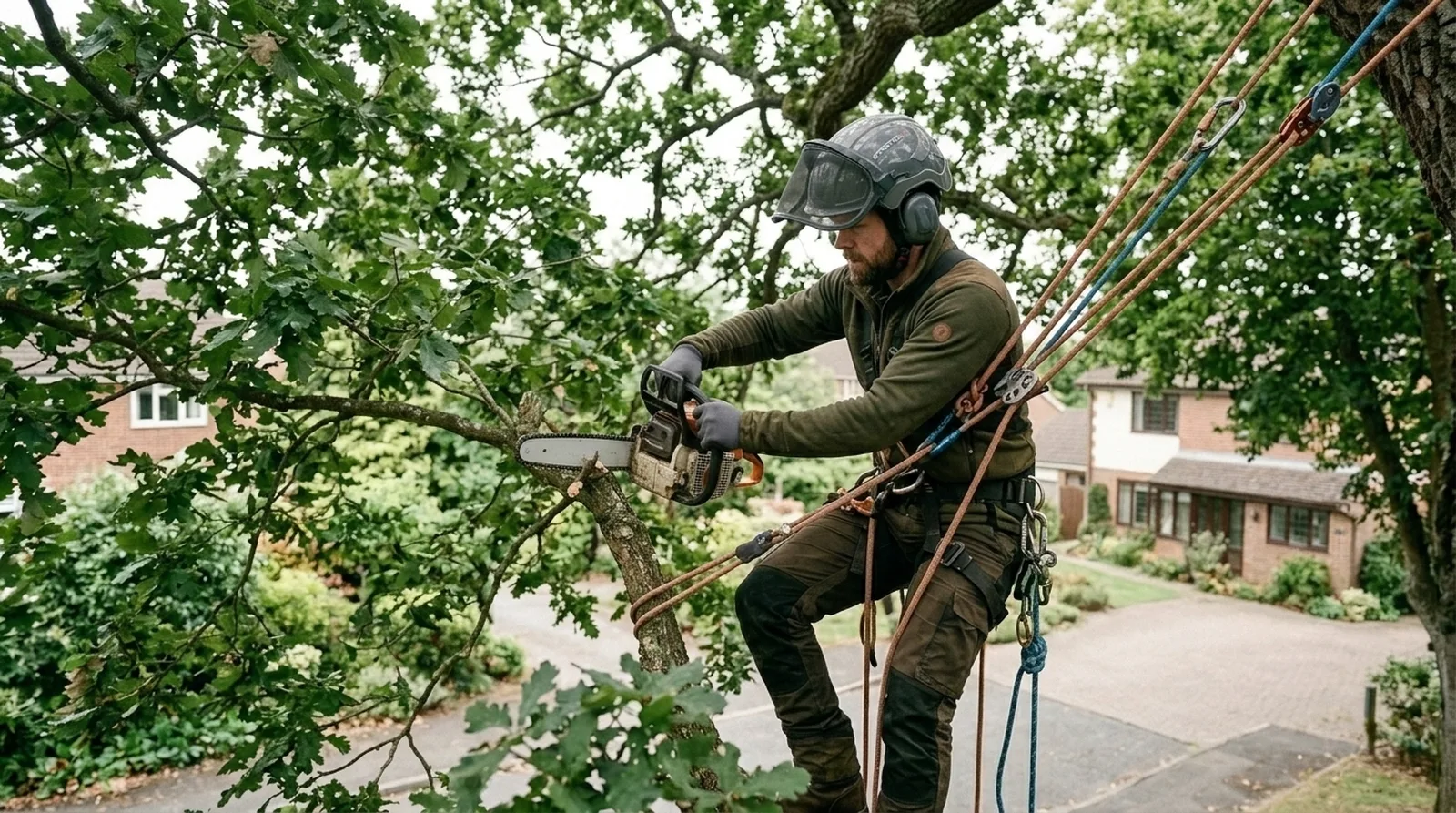
Commercial auto insurance covers the trucks, trailers, and chip trucks used for work. It exists because a personal auto policy typically excludes business use entirely: if a truck insured under a personal policy is in an accident while hauling a chipper to a job, the insurer can deny the claim outright once it’s clear the vehicle was being used commercially.
The same point comes up in the guide on starting a tree service business, so the short version here: any vehicle used for tree work, owned by the business or by an operator personally, needs a commercial auto policy or a commercial endorsement rather than relying on a personal policy to hold up.
Other coverage worth knowing about
Two additional coverages come up often enough in tree care that they’re worth understanding before a client or a growing job pipeline forces the question.
Inland marine / equipment coverage
Inland marine coverage, despite the nautical name, is the standard term for insuring tools and equipment that move between job sites rather than sitting in one fixed location: chainsaws, chippers, rigging gear, stump grinders. General liability and property insurance are built around a fixed address, so a chipper stolen off a trailer at a job site or damaged in transit often isn’t covered unless it’s specifically insured this way.
Umbrella or excess liability
Umbrella or excess liability adds a layer of coverage on top of your existing general liability and auto limits, kicking in once a claim exceeds what the underlying policy pays out. It becomes worth pricing out once you’re bidding larger commercial or municipal jobs, since those contracts often specify liability limits higher than a standard general liability policy carries on its own.
What drives tree service insurance cost up or down
Underwriters price tree service policies against a handful of specific factors, and understanding them is more useful than chasing a single “average” number.
- Claims history. A clean claims record over several years is one of the strongest levers for a lower premium; frequent or large past claims signal higher risk and tend to raise cost at renewal, sometimes sharply.
- Crew certifications. Some carriers weigh credentials like ISA Certified Arborist status (already defined in the guide on starting a tree service business) as a signal of lower risk, since certified operators are trained on standard safety practices.
- Work mix. A business doing mostly climbing and rigging removals carries a different risk profile than one doing mostly ground-level pruning or bucket-truck work, and premiums reflect that difference.
- Payroll size. Workers’ compensation is typically rated against total payroll, so adding crew or raising wages tends to move that premium even when nothing about the risk profile itself has changed.
Certificates of Insurance (COI): what they are and when you’ll be asked for one
A Certificate of Insurance is the document that turns “we’re insured” into something a client can actually verify, and it comes up constantly once you’re working with commercial or municipal customers.
What’s actually on a COI
A COI is usually a one-page document issued by your insurance carrier or broker. It lists the type of coverage (general liability, workers’ comp, and so on), the policy limits, the policy number, and the expiration date. It confirms that a policy is active as of the date it’s issued; it doesn’t guarantee coverage will still be active later, which is why some clients ask for an updated COI on longer projects.
Commercial and municipal clients that require one
Property management companies, general contractors, HOAs, and municipal or utility contracts commonly require a COI before work starts, and some name themselves as an “additional insured” on the certificate for the duration of the job. This tends to come up most often on larger bids, the same territory covered in the guide on how to bid a tree job. The bigger and more commercial the job, the more likely a COI request shows up somewhere in the process, sometimes before a quote is even finalized.
How fast a broker can typically issue one
Most brokers can issue a COI same-day or within a business day or two once a policy is active, since it’s a standard document generated from information the carrier already has on file. Operators who keep a current COI on hand, rather than requesting one only after a client asks, tend to move faster through the early stages of a commercial bid. Some attach a current COI alongside the written quote itself, so the question doesn’t have to come up separately once a client is ready to say yes.
If you write quotes through ArboristDesk, that’s built in directly: upload your current COI once in Settings, then check “Attach COI” on any estimate to send it as a second attachment alongside the quote, with a copy on hand in the client portal and a reminder 30 and 7 days before it expires, so it doesn’t lapse without you noticing.
Common exclusions and gaps to check before you sign
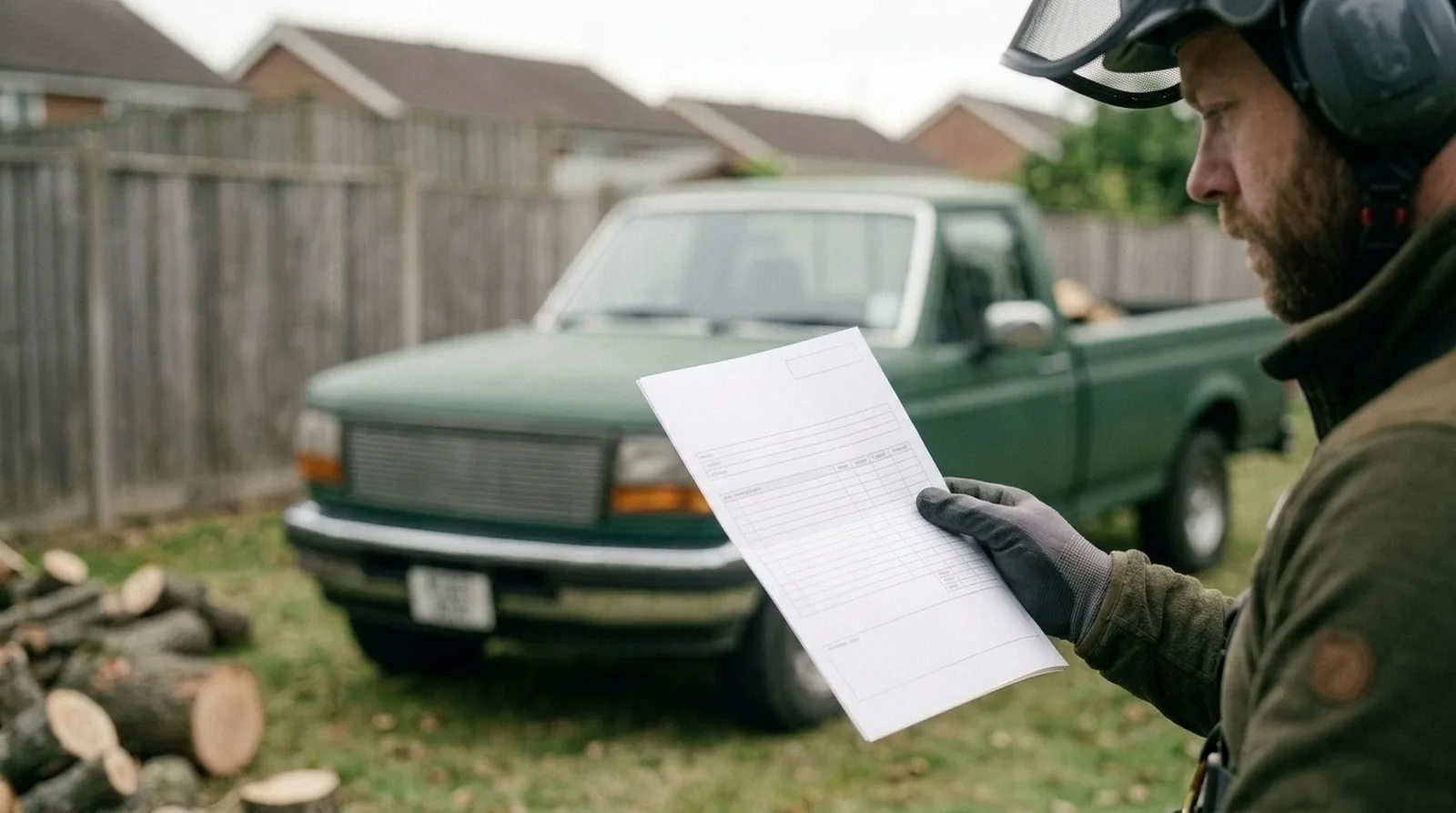
Every policy has boundaries, and the gap between what an operator assumes is covered and what actually is tends to surface at the worst possible time: mid-claim. Ask an agent to walk through these specifically rather than assuming either way.
- Aerial lift or bucket truck operation. Some general liability policies exclude aerial lift work by default or require a specific rider or endorsement to include it, so confirm whether bucket truck operation is actually covered before you rely on it.
- Prior tree-related claims. A history of claims tied to tree work specifically, not just claims in general, can trigger higher premiums or added exclusions at renewal, so ask how your carrier weighs claim type as well as claim count.
- Subcontracted crew or day labor. If a subcontractor or day laborer isn’t covered under your policy or carrying their own, a gap can open up that neither party realizes exists until an injury or damage claim forces the question. Confirm in writing whether subcontracted help is covered under your policy before a job starts.
How to lower your premium without cutting corners
None of these levers involve carrying less coverage than you need. They’re about shopping and documenting smarter around the coverage you’re already required to carry.
Bundling policies with one carrier
Carrying general liability, commercial auto, and workers’ comp with the same carrier often earns a discount compared to buying each separately, and it simplifies renewal since everything comes up for review at once instead of on staggered dates.
Documented safety training and certifications
Keeping records of crew safety training, certifications, and any formal safety program gives an underwriter something concrete to weigh at renewal, and it’s the same documentation that supports a COI request or a larger commercial bid.
Shopping multiple quotes annually instead of auto-renewing
Letting a policy auto-renew year after year without comparing quotes is one of the more common ways operators end up paying more than they need to. Getting two or three quotes at renewal, even when you end up staying with the same carrier, keeps pricing honest and surfaces coverage gaps a single renewal notice wouldn’t.
Frequently asked questions
What insurance does a tree service need?
Three coverages cover most of the risk: general liability for damage or injury your work causes to someone else, commercial auto for the trucks and trailers you use on the job, and workers’ compensation as soon as you bring on your first employee. Most states treat workers’ comp as mandatory at that point, and it tends to be one of the higher-premium trade classifications because of the physical risk involved.
How much does tree service insurance cost?
Cost varies by state, crew size, and claims history, so there’s no single number that applies everywhere. As of August 2026, general liability alone for a tree service runs roughly $1,650 to $2,850 a year depending on which published source you check, per the medians Insureon and MoneyGeek publish, though your specific state and business size can move that either direction. Workers’ compensation is priced separately, usually against payroll, and tends to cost more than general liability because of tree care’s risk classification.
Why is workers’ comp so expensive for tree care specifically?
Tree care is rated as one of the higher-risk trade classifications because of climbing, chainsaw use, falling limbs, and proximity to power lines, all of which tend to drive up claims frequency and severity compared to lower-risk trades. Carriers generally price the risk accordingly, and specifics vary by state and carrier.
What is a Certificate of Insurance (COI) and when do I need one?
A COI is a document from your insurance carrier confirming your active coverage, policy type, and limits. Many commercial and municipal clients require one before work starts, and some request it be sent alongside your quote rather than after the job is awarded.
Does tree service insurance cover storm damage or fallen trees?
That typically depends on the specific policy and whose property is involved. A homeowner’s own fallen tree is usually a claim against their homeowner’s policy, not the tree service’s. A tree service’s liability policy generally covers damage or injury the crew causes while doing the work, not pre-existing storm damage. Confirm specifics with an agent rather than assuming coverage either way.
What isn’t covered by a typical tree service insurance policy?
Common gaps include aerial lift or bucket truck operation without the right endorsement, damage from work performed outside the scope described on the policy, and subcontracted crew who aren’t covered under either your policy or their own. Ask an agent to walk through exclusions specific to your policy before you rely on it.
How can I lower my tree service insurance premium?
Bundling policies with a single carrier, maintaining a clean claims history, documenting crew safety training and certifications, and shopping multiple quotes at renewal instead of auto-renewing are the levers operators most commonly use without cutting the coverage itself.
Once the paperwork side of the business is under control, ArboristDesk keeps the quoting and scheduling side simple too. Check pricing when you’re ready to compare plans.