 Arborist
How to start a tree service business: a step-by-step guide
Starting a tree service business usually means getting a general business license (and sometimes a specific tree-trimming license), carrying general liability insurance before you take a single job, buying a realistic starter kit of chainsaws and rigging gear rather than a bucket truck, and lining up your first few customers through people who already know your work. Everything else, including software, can wait.
What it actually takes to start a tree service business
Most people who ask “what do I need to start a tree service business” already have the hard skill: they’ve climbed, run a chipper, or led a ground crew for someone else, and they’re deciding whether to go out on their own. The good news is that the barrier to entry is lower than in most trades. A lot of tree work can be done with hand tools, a chainsaw, and a chipper, not a fleet of heavy equipment.
The parts that trip people up aren’t technical. They’re the business basics: getting licensed correctly for your state and county, carrying the right insurance before, not after, your first job, pricing work so it actually covers your costs, and finding customers without burning the relationship with your current employer. This guide walks through each of those in order, roughly the sequence you’d tackle them in during your first few months.
Get licensed and certified
You’ll need at least a general business license before you can legally invoice a customer, and depending on where you operate, possibly a specific tree-trimming or arborist license as well.
State and local business licensing basics
Licensing requirements for tree services aren’t federal or even consistent state to state. Some states require a general contractor or home improvement contractor license for any work touching residential property, others require a specific tree-trimming or landscaping license, and some counties layer on their own permit for tree removal near property lines or protected species. The only reliable way to know what applies to you is to call your city or county clerk’s office directly and ask what’s required for a tree service operating in that jurisdiction, before you take paying work. Doing this early also avoids a common mistake: quoting a job, then discovering a permit requirement that delays the start date and irritates the customer.
ISA Certified Arborist: is it required?
No. ISA (International Society of Arboriculture) Certified Arborist status is not a legal requirement to run a tree service business in almost any US jurisdiction. What it does is signal competence to people who can’t otherwise judge it: insurance underwriters, property managers, and higher-value residential or commercial clients often ask for it specifically, and some municipal or utility contracts require it outright. If you’re weighing whether to get certified before or after launch, it’s worth it for the trust signal even though it costs time and an exam fee, but it isn’t a gate you have to clear to start taking jobs.
Certification through ISA applies to the person, not the company, so a licensed business can operate legally with no certified arborist on staff. Some owners look at company-level credibility instead, through TCIA (Tree Care Industry Association) accreditation, a periodic third-party review of a company’s safety practices, training, and business operations. It’s optional and mostly matters once you’re bidding larger commercial or municipal contracts, but it’s worth knowing the name if a prospective client asks whether you’re accredited.
Get insured before you take your first job
This is the one step that isn’t optional in practice, even in places where it isn’t strictly required by law.
At minimum, you need general liability insurance, which covers property damage and injury claims if something goes wrong on a job (a limb through a greenhouse roof, a rigging line that snaps near a fence), and commercial auto insurance for any vehicle used for work, since a personal auto policy typically excludes business use. Once you hire your first employee, most states require workers’ compensation as well, and this usually isn’t something you can defer.
General liability insurance and workers’ compensation get confused often, and they cover different things. General liability protects against damage or injury you cause to someone else’s property or person. Workers’ compensation protects your own employees if they’re hurt on the job, and it’s a separate policy with separate rules by state.
There’s a practical reason this can’t wait: many residential customers now ask for a Certificate of Insurance (COI), a document from your insurer confirming active coverage, before they’ll book a job at all. If you don’t have one ready, you lose the job to whoever does. Carrier selection and coverage limits are their own topic, worth researching separately once you’re closer to writing your first quote.
Buy or lease the equipment you actually need to start
The equipment list for a new tree service is shorter than most people expect, and the temptation to buy more than you need early is one of the more common ways new operators burn through startup cash.
Minimum viable equipment for a 1-2 person crew
- A chainsaw set: at least one mid-size saw for ground work and a smaller top-handle saw for climbing
- Climbing and rigging gear: harness, ropes, carabiners, and a rigging system appropriate for the tree sizes you’ll actually take on
- Personal protective equipment: helmet, chaps, eye and ear protection for each person on the crew
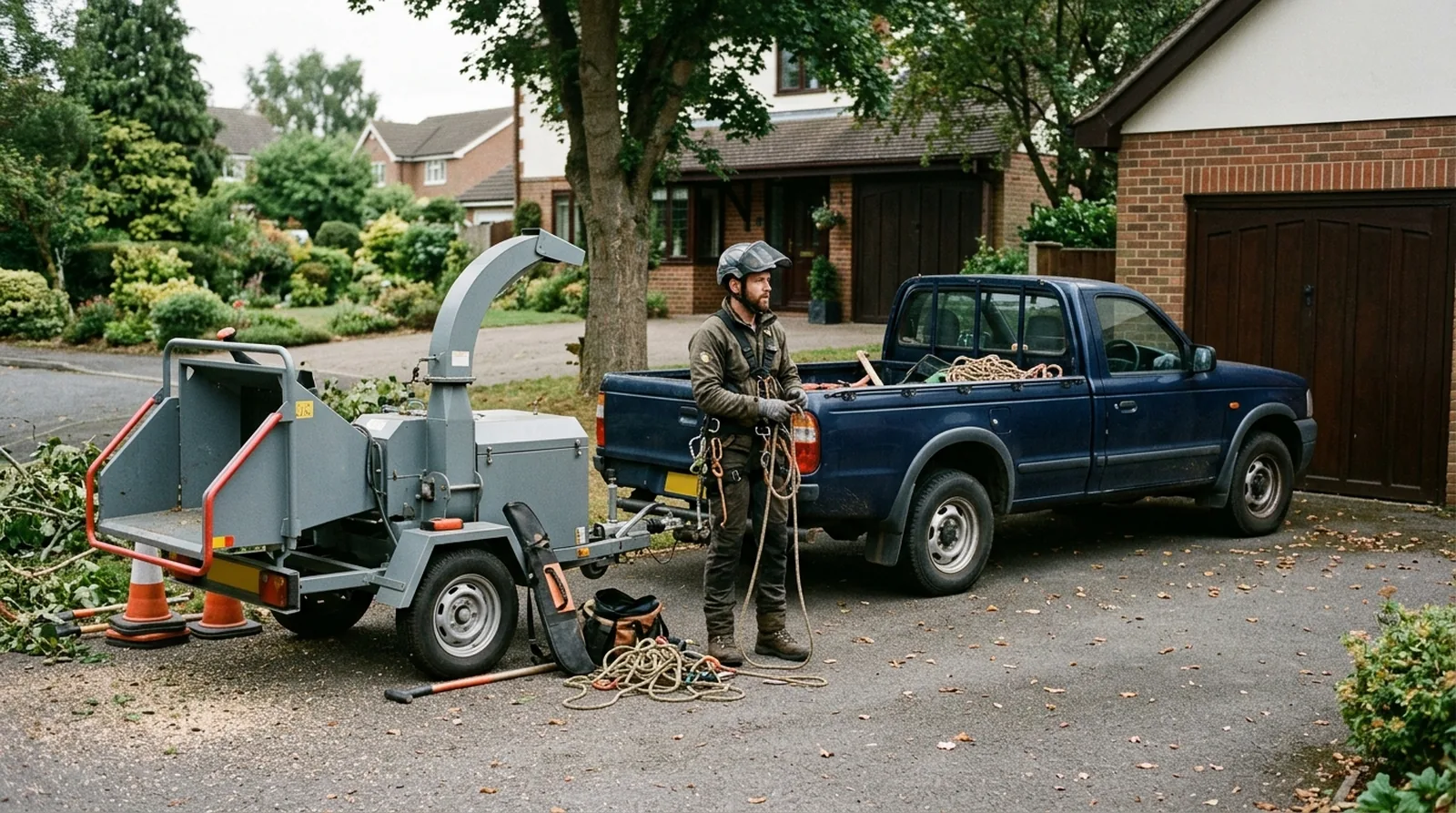
- A chipper, sized to the branch diameter you expect to handle most often
- A truck or trailer with enough capacity to haul debris and tow the chipper
What to rent or subcontract instead of buying on day one
Bucket trucks, stump grinders, and cranes are the equipment most new operators assume they need and, in practice, rent or subcontract for the occasional job that calls for them. A stump grinder used twice a month doesn’t justify the purchase price and storage space when a rental or a local subcontractor can cover it. The same logic applies to a bucket truck: unless a large share of your early jobs genuinely require it, renting keeps cash available for the parts of the business that need it more, like insurance and marketing.

Write a simple business plan
A tree service business plan doesn’t need to be investor-grade. What it needs to do is force you to write down the handful of decisions that otherwise stay vague in your head until a customer or a bank asks about them.
At minimum, it should cover:
| Section | What to include |
|---|---|
| Service area | The towns, counties, or radius you’ll actually drive to for a job |
| Services offered | Removal, trimming, stump grinding (owned or subcontracted), storm cleanup, and anything you’ll explicitly say no to at first |
| Pricing approach | Whether you’ll quote line-item or lump-sum, and roughly how you’ll set rates against local competitors |
| Startup cost estimate | The equipment, insurance, and licensing costs from the sections above, totaled |
| First-90-days customer plan | Where your first jobs will realistically come from, covered in the customer acquisition section below |
Writing this down takes an afternoon, not a week, and it’s the reference you’ll come back to when you’re deciding whether to take a job outside your usual service area or add a service you haven’t priced before.
Estimate your startup costs
Startup costs for a tree service vary widely by region, and mostly by how much of your equipment you buy new versus used or rent instead of buy. There isn’t one accurate number that applies everywhere, so treat the ranges below as a planning tool, not a quote.
| Line item | Typical range | Note |
|---|---|---|
| Chainsaws, climbing and rigging gear, PPE | A few thousand dollars | Buying used saws and gear from other operators cuts this substantially |
| Chipper | Ranges widely | Many new operators rent per job instead of buying until volume justifies it |
| Truck or trailer | Usually the largest single line item | A used truck with adequate towing capacity is the common starting point |
| General liability insurance | Roughly $1,500 to $3,000 a year for a one-person operation with no employees | Current quotes cluster in that band; premiums rise once you add crew and vehicles, so get quotes from more than one carrier (Insureon, MoneyGeek) |
| Licensing and permits | Usually modest at the city or county level | Varies enough by jurisdiction that a local phone call is more reliable than any published figure |
| Marketing and website | Low, if you handle it yourself | A simple site plus a Google Business Profile listing covers most of what a new operator needs at first |
| Software | Little to nothing at first | Most new owner-operators start on paper or a spreadsheet, covered in the day-to-day operations section below |
The realistic range that shows up across equipment retailers, insurance quote sites, and small business cost guides runs from a lean, mostly-rented setup on the low end to a fully equipped crew with owned chipper and stump grinder on the high end. Where you land depends on how much you already own from prior work, how much you buy used, and how aggressively you rent instead of buy in year one.
Price your first jobs
Pricing is where a lot of new tree service owners lose money without realizing it until the season’s over.
Why undercutting the market backfires
It’s tempting to price low to win your first jobs, especially when you’re competing against operators who’ve been established for years. The problem is that a tree service business runs on repeat and referral work, and pricing so low that a job barely covers fuel and chipper rental doesn’t leave room to invest back into insurance, better equipment, or hiring help when volume picks up. A price that’s competitive but sustainable does more for the business long-term than a price that wins the job and loses money on it.
Line-item quoting vs. lump-sum
Line-item quotes break a job into its parts (removal, cleanup, stump grinding, debris haul) and price each one separately, which makes it easier for a customer to see where their money’s going and to say yes to some parts and no to others. Lump-sum quotes give one number for the whole job, which is faster to write but harder to defend if a customer asks why it costs what it does, or wants to remove one item to bring the price down. Most new operators find line-item quoting builds more trust early on, since it doubles as proof you’ve actually thought through the scope of the job.
A free estimate template is a reasonable starting point if you’re not ready to build your own quoting format from scratch, and it saves you from rebuilding the same line items by hand every time a new job comes in.
Find your first customers
A consistent pattern shows up across arborist forums and industry discussions: new operators rarely start with paid advertising. They start with people who already know their work.
Word of mouth and referrals
If you’re leaving a job to go independent, the people most likely to hire you first are homeowners and property managers who’ve seen your work directly, not the employer’s client list itself. There’s a real line here: reaching out to a former employer’s active customers to solicit their business is a good way to burn a professional relationship and, in some cases, invite legal trouble if there’s a non-compete or non-solicitation clause involved. Friends, family, neighbors, and people you’ve worked alongside on other crews are a cleaner starting point, and referrals from those first few jobs tend to compound faster than people expect.
Google Business Profile and local visibility
A claimed and filled-out Google Business Profile listing is close to a baseline requirement now, since it’s what puts you on the map when someone searches “tree service near me” or looks at the map pack before calling anyone. Photos of completed jobs, a phone number that gets answered, and a handful of real reviews from early customers do more for local visibility in the first few months than most other marketing efforts combined.
Door hangers and local Facebook groups
Arborists on forums consistently mention two low-cost channels that keep producing leads long after the novelty wears off: door hangers left in neighborhoods where you’re already working (a storm cleanup job in one yard is a natural reason to leave a hanger next door), and local Facebook groups or neighborhood apps where people ask for recommendations. Both cost time rather than money, which fits the reality that most new tree services aren’t running paid ad budgets in year one.

Set up how you’ll run the business day to day
Most new owner-operators start with a notebook, a spreadsheet, or a mix of Google Sheets and a messaging app to keep track of jobs, quotes, and who owes what. That’s a reasonable way to start, and it works fine at low volume, when there’s really only one person who needs to remember anything.
The point where it stops working is usually predictable: once you’re running more than a handful of jobs a week, or you’ve hired a second person, keeping schedules, quotes, and invoices straight in your head or across three different apps starts costing more time than it saves. That’s the point where dedicated tools for crew scheduling, invoicing, and customer records tend to earn their keep, not because paper stops working entirely, but because the time spent re-entering the same job information into three places is time that isn’t billable. There’s no reason to switch before you feel that friction yourself.
Once quoting and scheduling by hand stops keeping up, ArboristDesk keeps it simple. See how estimating works, or check pricing when you’re ready to compare plans.