 Arborist
Tree service equipment cost guide (2026)
A realistic 1-2 person starter kit, chainsaws, climbing and rigging gear, and PPE, typically runs a few thousand dollars before you add a truck or trailer, per ArboStar’s 2026 tree service equipment cost breakdown. A fuller crew setup that adds an owned chipper, and eventually a bucket truck, moves the total well into five or six figures, which is exactly why most 2-15 person operators rent or subcontract the biggest-ticket items rather than buying everything up front.
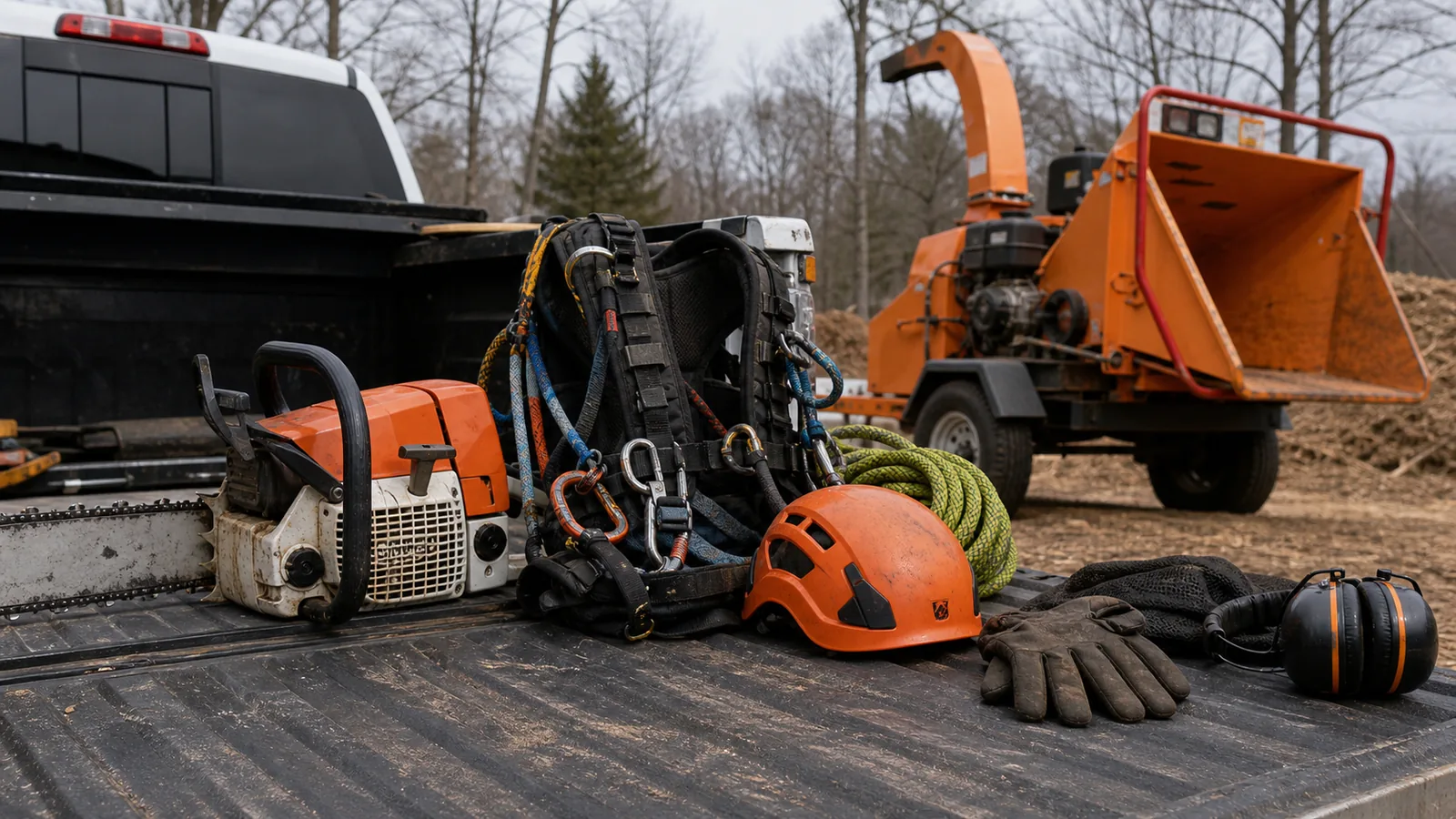
What a realistic starter kit actually costs
The guide on starting a tree service business covers startup costs at a high level: chainsaws, climbing and rigging gear, PPE, and a truck or trailer, without pinning down category-by-category numbers. This guide breaks down arborist equipment cost the same way a working operator actually budgets it, from hand tools and tree cutting instruments up to the heavy equipment most crews rent before they own.
| Category | Typical cost range | Buy new, buy used, or rent? |
|---|---|---|
| Chainsaws (single professional saw) | $500-$1,500 | Buy, ideally your primary saw new |
| Climbing and rigging gear (full kit) | ~$1,000-$1,900 | Buy, used gear from other operators cuts this substantially |
| Wood chipper (entry-level, tractor-mount) | $1,700-$5,000 new | Buy once volume is steady |
| Wood chipper (commercial towable, 12“+) | $35,000-$90,000+ new | Rent until volume justifies owning |
| Bucket truck (standard used forestry unit) | $30,000-$50,000 | Rent or subcontract until justified |
| Stump grinder (walk-behind) | $1,800-$8,000 new, $500-$3,000 used | Rent for occasional jobs |
| PPE per crew member | $1,300-$2,600 | Buy new, non-negotiable safety gear |
Sources for every figure above are cited in the sections below. Treat this table as a planning reference, not a quote, since region, condition, and brand all move these numbers.
Chainsaws and climbing/rigging gear
Chainsaws
A single professional-grade chainsaw typically runs $500 to $1,500, per ArboStar’s 2026 equipment cost list (ArboStar, “Professional Tree Service Equipment Cost List”), a range broadly consistent with general professional chainsaw pricing guides that put commercial-grade saws at roughly $400 to $1,200 and up. A realistic saw lineup for a small crew pairs one heavier saw for bucking and ground work with a lighter top-handle model built for one-handed use in the canopy, a design a ground crew member would never actually need. Top-handle climbing saws tend to sit in the middle-to-upper end of that range rather than the bottom.
Climbing and rigging gear
A functional beginner tree climbing gear setup, saddle or harness, climbing rope, flipline, and hardware, runs approximately $1,000 to $1,900 pieced together from arborist supplies retailers such as WesSpur and Sherrilltree. A tree climbing harness alone commonly runs $300 to $800 depending on padding and attachment points, a climbing rope $150 to $300, and a flipline $100 to $200, with carabiners, pulleys, and other rigging hardware adding another $50 to $150. Buying a pre-assembled climbing equipment kit rather than piecing components together individually is usually the cheaper starting point, and buying used gear from another operator cuts the total further, though safety-critical items like rope and harnesses are worth more scrutiny used than a chainsaw is.
Wood chippers
Chipper pricing splits sharply by capacity and feed type, which is why a single “average chipper cost” figure is close to meaningless without knowing which class of machine it describes.
Cost range: new vs. used
Entry-level, smaller-capacity chippers built for tractor mounting start around $1,700 to $5,000 new, and scale up from there with feed system (disc vs. drum) and horsepower (Heavy Equipment Appraisal, “Wood Chipper Cost: New vs Used Prices”). A full commercial towable chipper in the 12-to-15-inch capacity range, the size most tree services actually run daily, costs $35,000 to $60,000 new, and an 18-inch drum-feed production unit runs $60,000 to $90,000, per the same source. ArboStar’s broader tree-service-specific figure of $15,000 to $100,000 for an owned chipper spans roughly the same commercial range. Used units sell for meaningfully less, but condition and hours matter enough that a per-machine inspection is worth more than any published used-price average.
Rental vs. buy
Wood chippers rent for roughly $150 to $450 a day, $480 to $1,620 a week, or $1,275 to $4,275 a month, according to current 2026 rental-market pricing (Rentd, “How Much Does It Cost to Rent a Wood Chipper?”). For a low-volume operator, renting avoids the maintenance, storage, and insurance cost of ownership, and it’s the right call until a chipper is in near-weekly use. Once utilization gets there, ownership typically pays for itself faster than continuing to pay repeated rental fees, though no published source gives a specific breakeven job count, since that depends on local rental rates and how much of your work actually needs chipping versus hauling debris whole.
Bucket trucks and aerial equipment
Cost range: used vs. new
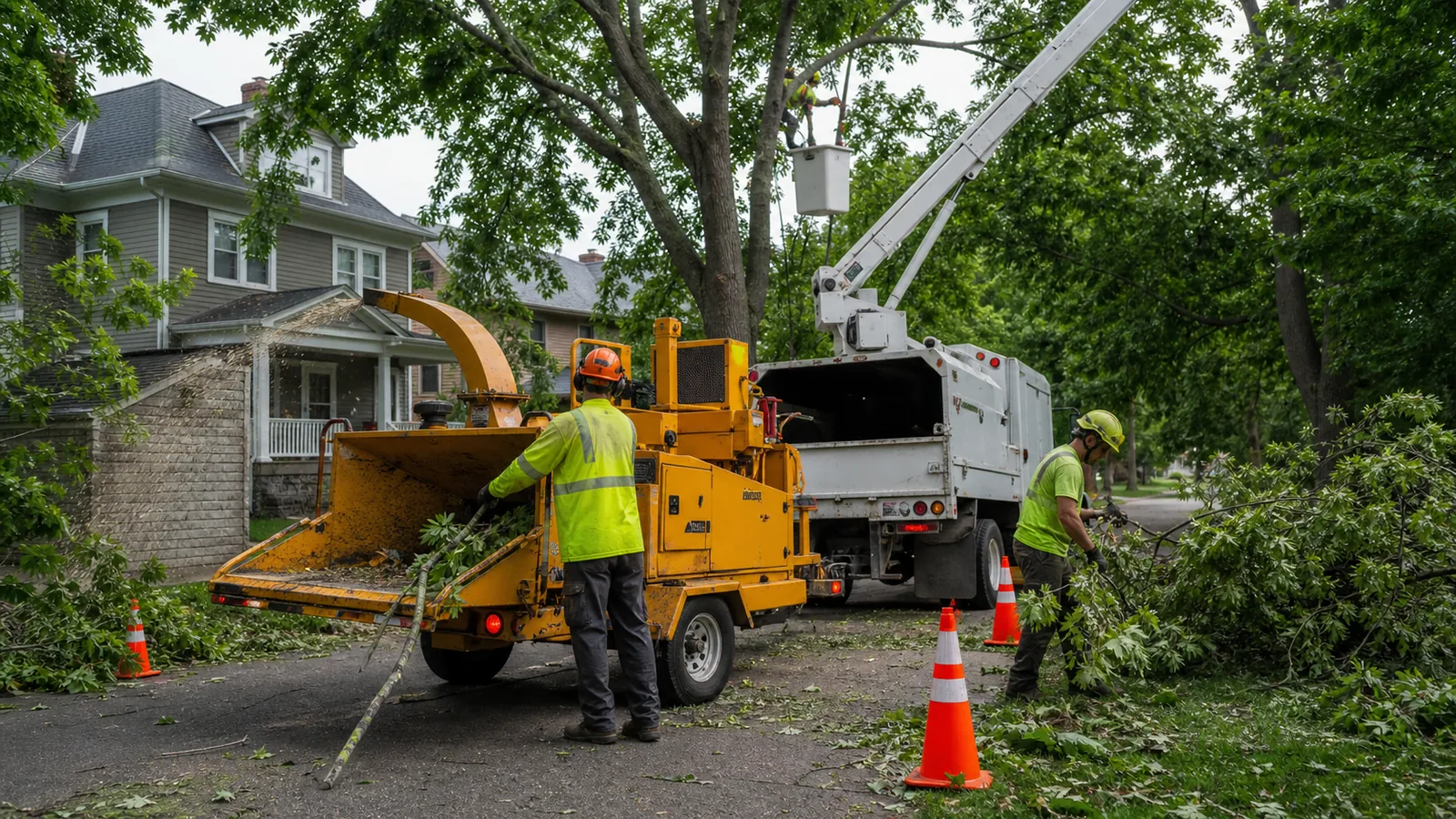
A standard used forestry bucket truck with a 60-foot reach and chipper body typically runs $30,000 to $50,000, per ArboStar’s equipment cost breakdown (ArboStar, “Professional Tree Service Equipment Cost List”). Broader marketplace data shows just how wide the full range runs: ForestryTrader lists forestry bucket trucks from roughly $7,000 to well over $400,000, with an average listing price around $64,000 (ForestryTrader, forestry bucket truck listings), reflecting everything from older, shorter-reach units to new, high-capacity booms. For a 2-15 person operation, the $30,000-to-$50,000 range for a standard used unit is the more realistic reference point than the marketplace average.
Rent, subcontract, or buy
Most 2-15 person crews start by renting or subcontracting aerial work rather than owning a bucket truck. Daily rental rates run roughly $200 to $500 for a standard 32-to-45-foot boom truck, with larger or specialty units running $350 to $1,000-plus a day; weekly rates average $1,200 to $2,000, and monthly rentals run $3,500 to $7,000 (The Pricer, “How Much Does Bucket Truck Rental Cost?”). Ownership makes sense once aerial work is frequent enough that rental and delivery fees consistently exceed what a monthly payment on an owned unit would cost, but for most new and growing operators, renting or subcontracting removes a five-figure purchase and its maintenance cost from the startup equation entirely.
Stump grinders
Stump grinders follow the same rent-first logic as bucket trucks for most operators. New walk-behind units run $1,800 to $8,000 depending on size, with used units available for $500 to $3,000 in good condition (Rubbl, “How Much Does a Stump Grinder Cost?”). Tow-behind and self-propelled commercial models scale much higher, commonly $8,000 to $50,000 for a used towable unit and into six figures for the largest self-propelled machines. Daily rental for a stump grinder runs about $180 to $600 depending on size (Jobber Academy, “Tree Service Equipment List”), which covers most operators’ needs until grinding is a regular enough part of the job mix to justify ownership.
PPE and safety gear
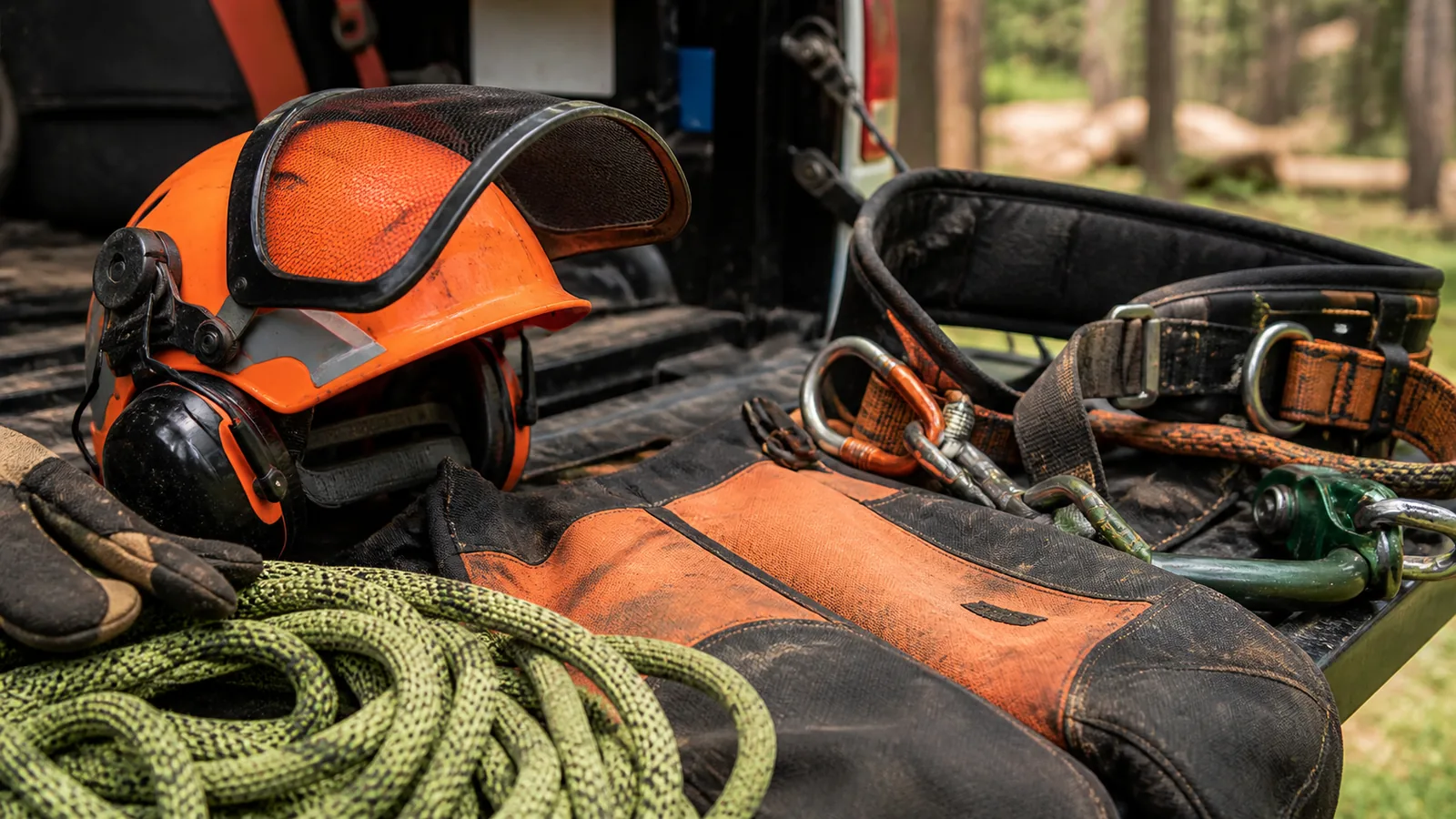
PPE is the one category of arborist supplies where buying new, rather than used, is close to non-negotiable. A fully equipped arborist’s safety gear runs roughly $1,300 to $2,600 total, per ArboStar’s 2026 cost breakdown (ArboStar, “Professional Tree Service Equipment Cost List”). Within that total, a professional-grade helmet with integrated face shield and ear protection runs $87 to $584 depending on features, and a professional-grade harness commonly costs $350 to $400. Chainsaw-resistant chaps or pants add a smaller line item on top. Compliance with ISA/ANSI Z133 equipment standards isn’t optional for a professional crew, and cutting corners here shows up later as higher insurance premiums or a failed safety review, not just as saved cash today.
Buy new, buy used, or rent: a simple decision framework
Across every category above, the same pattern holds: buy what protects the crew and what you use on every single job, and rent or subcontract what’s expensive to own and only needed some of the time.
- Buy new: PPE and your primary chainsaw. These are the items where used condition is hardest to verify, and failure carries the highest safety cost.
- Buy used once you’re confident in the deal: chippers, stump grinders, and eventually a bucket truck, once volume justifies ownership. Pricing on these categories varies enough by condition and hours that an in-person inspection matters more than any published average.
- Rent or subcontract until volume justifies owning: bucket trucks, cranes, and stump grinders, for most 2-15 person operators. The math tends to flip toward ownership only once a category of equipment is in near-weekly use, not occasional use.
How equipment cost feeds into your pricing
None of the numbers above matter much if they don’t make it into what you charge. The guide on how to bid a tree job builds an all-in hourly cost, labor, equipment, and overhead combined, and equipment cost (depreciation, fuel, and maintenance) is one of the three inputs to that number, not a separate line item you eyeball afterward. Job costing for tree service covers the other half: checking after the fact whether a job’s actual equipment time and cost matched what you built into the bid.
Once you know your real equipment cost, a structured format helps turn that number into an actual quote rather than a guess written on the spot. A free tree service estimate template gives you the line items to fill in with your own numbers.
Once your real costs are dialed in, see how estimating works to build accurate quotes on the spot instead of at the office that evening. Check pricing when you’re ready to compare ArboristDesk plans.